It is the age of AI – while AI is evolving many aspects of human interactions, the impact on software is particularly interesting. There is an opportunity for developers to infuse apps with solutions powered by generative AI and large/small language models – the end result should be smarter apps and better user experiences. Modern AI is also a huge opportunity to streamline and automate developer workflows for better productivity – AI can do much of the mundane code writing, freeing up developers to review code and guide architectural decisions.
As software developers increasingly leverage AI Agentic workflows to ship code, context is absolutely the key – specialized instructions or tools can provide grounding and help AI perform repeatable tasks. With Agentic AI, two concepts come up a lot: MCP Tools and Skills – they’re related, but they solve very different problems.
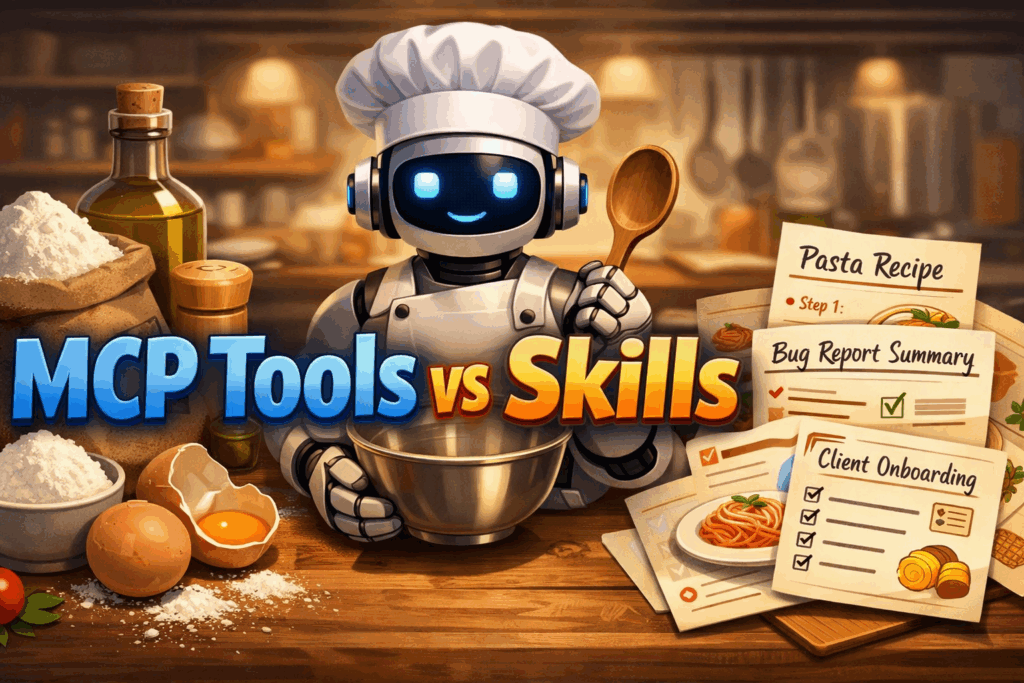
If you are a developer who is a foodie or loves to cook, a useful way to think about them is through food prep:
- MCP Tools are ingredients
- Skills are recipe cards
- The AI Agent is the cook
Let’s unpack that.
What are MCP Tools
MCP Tools = Ingredients 🥔 🥩
MCP (Model Context Protocol) tools expose specific contextual capabilities to an AI agent. Each tool does one thing and does it well.
Developers should think of MCP Tools as AI Agentic know-how to pull off specific tasks:
- Search this database
- Call this REST API
- Read a file
In food terms, these are raw ingredients:
- Flour
- Eggs
- Salt
- Olive oil
By themselves, the raw ingredients aren’t very useful. You can eat flour, but you probably shouldn’t – in the hands of a skillful chef, the same flour can be turned into a yummy cake.
Key traits of MCP Tools:
- Atomic and focused
- Usually Stateless
- Usually offered by a framework/service/platform
- Discoverable and composable
- Not opinionated about why they’re used
MCP Tools answer: 👉 “What can the AI Agent do?”
What are Skills
Skills = Recipe Cards 📝 📇
Skills are higher-level behaviors and instructional guardrails. Skills define how and when tools should be used to accomplish something meaningful.
Developers should think of Skills as AI Agentic instructions towards accomplishing specific software tasks:
- Summarize a GitHub issue and create a task
- Onboard a new customer
- Analyze logs and produce a report
In cooking terms, a Skill is a recipe card:
- Step-by-step instructions
- Known good outcomes
- Reusable patterns
- Sometimes customized for taste
A recipe doesn’t grow tomatoes or mill wheat — it needs the raw ingredients, but orchestrates their use.
Key traits of Skills:
- Opinionated and goal-oriented
- Often multi-step
- Can call multiple tools
- Encapsulate domain knowledge
- Designed for reuse and consistency
Skills answer: 👉 “How should the AI Agent solve this problem?”
AI Agentic Workflows
The Agent = The Cook 👨🍳👩🍳
The AI Agent sits in the middle and coordinates what needs to be done to pull off a task.
- Chooses which recipe to follow or improvises
- Picks the right ingredients
- Adjusts based on context and constraints
A good cook doesn’t need to memorize the whole cookbook, just have recipe cards handy to know the steps need to followed to make a great meal. And the right tools absolutely help – fresh ingredients direct from source are the best.
Debunking Myths
Doom scrolling on social media might surface outlandish claims:
- MCP Tools are dead
- Skills are so overrated
- What’s wrong with take out food each dinner?
Serious software developers know the value of cooking right – eating well and healthy. And access to a personal chef is amazing – that’s what AI Agents bring to the table.
How to choose between MCP Tools or Skills: 👉 “Why not use both?”
The distinction between MCP Tool and Skill matters – this is important as developers expose context to AI Agents:
| Concern | MCP Tools | Skills |
|---|---|---|
| Abstraction level | Low | High |
| Reusability | Technical | Behavioral |
| Ownership | Platform / Framework | App / Domain |
| Stability | Long-lived | Evolves often |
| Dev mindset | “What APIs do we expose?” | “What workflows do we want?” |
While both are handy, there are consequences when the line between MCP Tools and Skills gets blurred:
- Tools become bloated
- Skills become brittle
- Agents get confused
- Developers lose control
Clean separation between MCP Tools and Skills provides composability without chaos.
Practical Rule of Thumb: If you’re wondering where something belongs, ask:
- Is this a capability? → MCP Tool
- Is this a workflow or pattern? → Skill
- Does it combine multiple steps with intent? → Skill
- Would other apps want this as-is? → MCP Tool
Back to food terms:
- If it goes in the pantry → MCP Tool
- If it’s pinned to the fridge → Skill
Now, let’s ask our AI chef to cook up something amazing for dinner. Cheers developers!
Next Steps
Ready to boost your productivity and simplify cross-platform .NET development? AI can help and Uno Platform MCP (Remote & App) Servers bring the context – AI is grounded in Docs/best practices and has eyes/hands to interact with the running app. Try it today – any OS, any IDE or with any AI Agent.
 Subscribe to Our Blog
 Subscribe via RSS
 Back to Top